
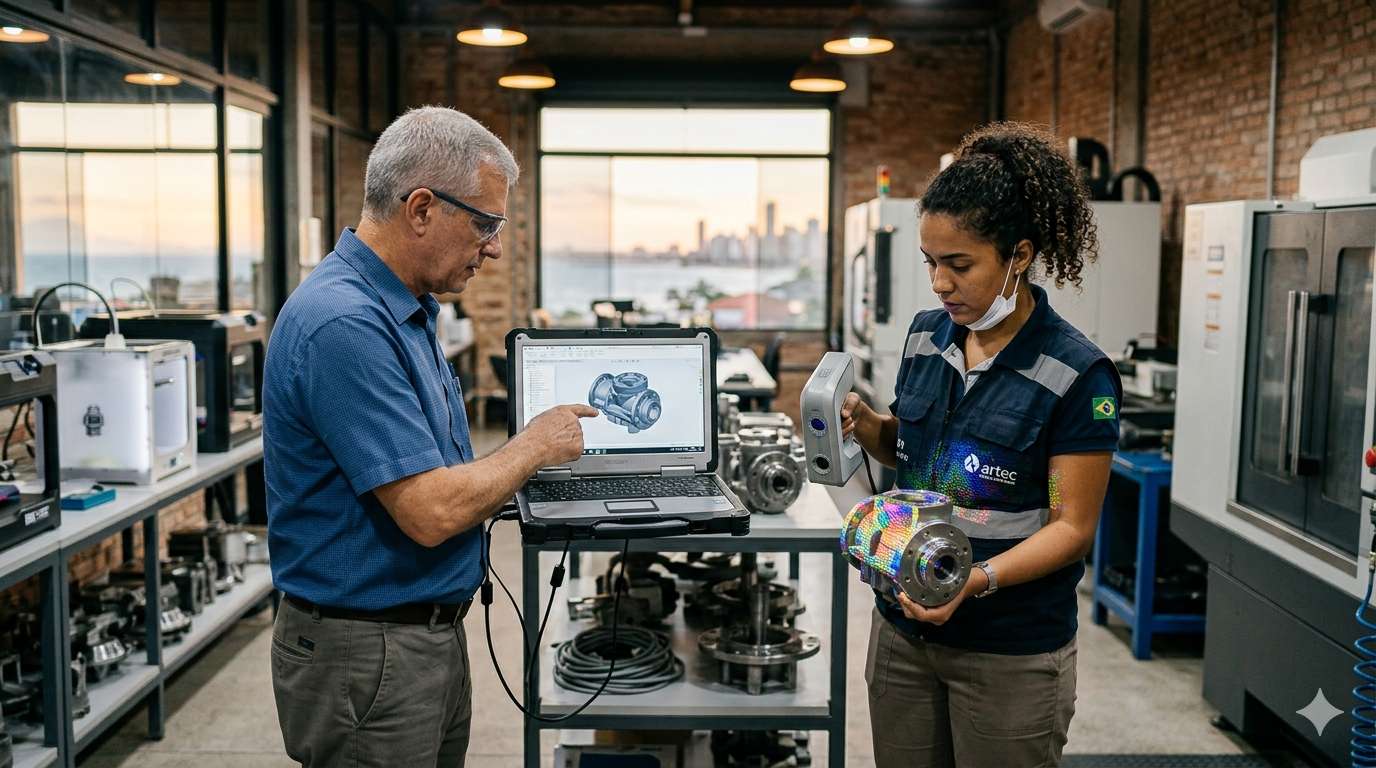
Depth Sensing | Industrial Inspection | Autonomous Robotics | Regional Breakdown | March 2026 | Source: MRFR
| $22.4B
Market Value by 2032 |
14.8%
CAGR (2024–2032) |
$8.1B
Market Value in 2024 |
Overview
3D Machine Vision Market global 3D Machine Vision Market is projected to grow from USD 8.1 billion in 2024 to USD 22.4 billion by 2032 at a 14.8% CAGR. The integration of structured light, time-of-flight (ToF), stereo vision, and LiDAR sensing technologies with AI-powered depth perception algorithms is enabling industrial automation, autonomous robotics, quality inspection, and logistics systems to achieve human-surpassing spatial accuracy — transforming 3D machine vision from a niche metrology tool into the universal perception layer for intelligent manufacturing, warehouse automation, and autonomous vehicle systems.
Key Takeaways
- The 3D Machine Vision Market is projected to reach USD 22.4 billion by 2032 at a 14.8% CAGR.
- AI-integrated 3D vision systems achieve sub-50 micron dimensional measurement accuracy, surpassing CMM tactile inspection speeds by 40x.
- Autonomous mobile robot (AMR) deployments requiring 3D perception are growing at 28% CAGR, creating the largest 3D vision volume segment.
- Semiconductor wafer inspection using 3D machine vision detects sub-20nm defects with 99.6% sensitivity — enabling sub-5nm node yield management.
- Time-of-flight (ToF) sensor cost has declined 78% since 2019, enabling mass-market 3D vision deployment across consumer and industrial applications.
Segment & Technology Breakdown
| Technology / Segment | Primary Buyer | Key Driver | Outlook |
| Structured Light 3D Inspection | Automotive, Electronics Mfg | Dimensional accuracy, surface defects | Dominant; sub-50 micron accuracy |
| Time-of-Flight (ToF) Sensors | Robotics, Consumer, Logistics | Real-time depth, cost efficiency | Fast-growing; 78% cost decline |
| LiDAR-Based 3D Vision | Autonomous Vehicles, Mapping | Long-range depth, outdoor SLAM | Strong; AV sensor suite demand |
| Stereo Vision Systems | AMR, Pick-and-Place, Bin Picking | Bin picking, object localisation | Growing; AMR integration wave |
| 3D AOI & Semiconductor Inspection | Semiconductor, PCB | Sub-nm defect detection, yield | High-value; 99.6% sensitivity |
What Is Driving Demand?
AI-Powered Depth Perception & Point Cloud Processing
Deep learning models trained on 3D point cloud data (PointNet++, VoxNet, SECOND) are enabling real-time semantic segmentation, object detection, and pose estimation from raw 3D sensor data — reducing 3D vision system integration time from months to weeks through pre-trained model APIs. AI-integrated 3D vision platforms achieve dimensional measurement accuracy below 50 microns at production line throughput rates of 1,200+ parts per minute, delivering inspection performance that simultaneously exceeds human accuracy and CMM tactile measurement speed by 40x.
Autonomous Mobile Robot (AMR) Perception Demand
The deployment of 4.2 million AMRs in global warehouse, manufacturing, and logistics environments by 2028 requires 3D perception systems for safe navigation, obstacle avoidance, bin picking, and collaborative human-robot workspace sharing. AMR 3D vision integration — combining ToF depth sensors, stereo cameras, and LiDAR — is the single largest volume driver for 3D machine vision components, with AMR deployments growing at 28% CAGR and consuming an estimated 38% of all 3D vision sensor units shipped globally by 2027.
Semiconductor & Advanced Electronics Inspection
3D machine vision inspection of semiconductor wafers, advanced packaging (chiplets, CoWoS, HBM), and PCB solder joint quality at sub-20nm defect detection sensitivity is enabling semiconductor manufacturers to manage yield at advanced process nodes (3nm, 2nm, sub-2nm) where even angstrom-scale defects cause catastrophic circuit failure. The USD 8.4 billion semiconductor inspection equipment market is the highest-ASP 3D vision vertical, with leading-edge fabs deploying 3D optical inspection tools at USD 2–8 million per system.
Automotive Body & Assembly 3D Metrology
Automotive OEMs deploying inline 3D measurement systems across body-in-white assembly, powertrain machining, and EV battery module inspection lines are achieving 100% part inspection coverage replacing statistical sampling — reducing dimensional non-conformance escape rates by 44% and warranty claim rates by 28% versus sample-based quality regimes. 3D vision-guided robot welding and assembly systems reduce joint positioning errors from ±0.5mm (teach-and-repeat) to ±0.05mm (vision-guided adaptive) — critical for EV battery pack sealing integrity.
ToF Sensor Cost Reduction & Mass-Market Adoption
Time-of-flight sensor manufacturing cost reduction of 78% since 2019 — driven by smartphone integration (iPhone Face ID, Android depth sensors) creating volume economies — has enabled 3D vision deployment across consumer robotics (robot vacuum navigation), logistics (parcel dimensioning), retail (cashierless checkout), and agriculture (precision spraying) applications previously economically inaccessible at USD 200–800 sensor price points. This cost democratisation is expanding the 3D vision TAM by an estimated 4x versus industrial-only definitions.
| Get the full data — free sample available:
→ Download Free Sample PDF | Includes market sizing, segmentation methodology & regional forecast tables. |
| KEY INSIGHT: Automotive and electronics manufacturers deploying AI-integrated 3D machine vision inspection across 100% of production output report 44% reduction in dimensional non-conformance escapes, 38% lower cost of quality versus statistical sampling regimes, and USD 6.2 million average annual quality and rework savings per high-volume production line — with 3D vision system payback periods averaging 10–16 months inclusive of hardware, integration, and AI model training costs. |
Regional Market Breakdown
| Region | Maturity | Key Drivers | Outlook |
| Asia-Pacific | Dominant | South Korea semiconductor, China manufacturing, Japan precision robotics | Dominant; highest inspection volume |
| Europe | Leader | Germany automotive metrology, DACH machine vision OEMs, EU Industry 4.0 | Strong; automotive + industrial vision |
| North America | Mature | Semiconductor fab inspection, AMR logistics, aerospace 3D metrology | Steady; semiconductor + logistics demand |
| Latin America | Emerging | Mexico automotive nearshoring, Brazil electronics, industrial automation | Growing; nearshoring CapEx catalyst |
| MEA | Expanding | UAE smart manufacturing, Saudi industrial city, Africa resource inspection | Accelerating; industrial investment |
Competitive Landscape
Key vendors include Cognex (3D vision), SICK AG, Keyence, Basler, Allied Vision, Intel RealSense, LMI Technologies, ISRA VISION (Atlas Copco), Photoneo, and semiconductor inspection specialists KLA, Applied Materials, and Onto Innovation. 3D sensor accuracy, AI model library depth, real-time point cloud processing speed, robot integration SDK quality, and semiconductor node-specific calibration are primary competitive differentiators.
Outlook Through 2032
The 3D Machine Vision Market through 2032 will be defined by AI point cloud processing enabling real-time 3D semantic understanding at industrial throughput rates, ToF and structured light cost democratisation expanding applications beyond traditional metrology into logistics, agriculture, and consumer robotics, semiconductor inspection scaling to sub-2nm node requirements, and AMR perception systems making 3D vision standard equipment on every autonomous robot shipped. Vendors delivering pre-trained 3D AI models, multi-sensor fusion platforms, and robot-native SDK integration will capture maximum market share as 3D vision transitions from specialist metrology instrument to universal machine perception infrastructure.
| Access complete forecasts, segment analysis & competitive intelligence:
Full Report: → Purchase the Full 3D Machine Vision Market Report (2025–2032) Free Sample PDF: Request Free Sample |
Source: Market Research Future (MRFR) | All market projections are forward-looking estimates and subject to revision. © MRFR · marketresearchfuture.com