
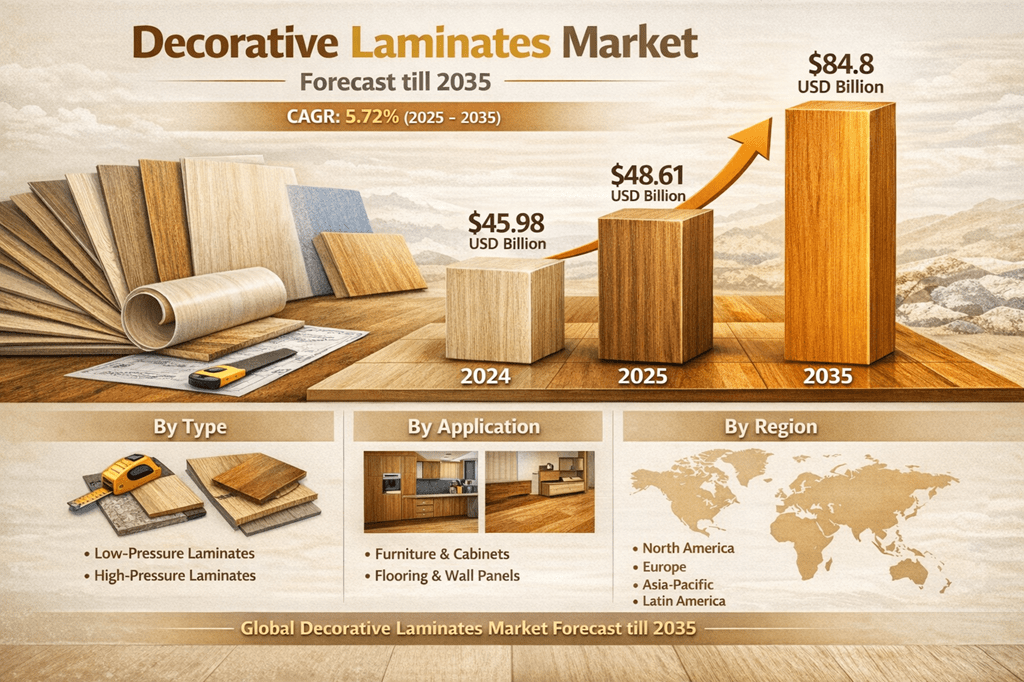
According to a comprehensive analysis by Market Research Future, the global Decorative Laminates Market was valued at USD 45.98 billion in 2024 and is projected to climb from USD 48.61 billion in 2025 to USD 84.8 billion by 2035, advancing at a compound annual growth rate (CAGR) of 5.72% over the forecast period. This robust near-doubling of market value across a decade reflects the powerful convergence of urbanization, rising consumer aspirations for beautiful living and working environments, a booming construction sector across emerging economies, and a deepening integration of sustainability and digital design innovation into the laminate manufacturing and specification process.
What Are Decorative Laminates and Why Do They Dominate Interior Surfaces?
Decorative laminates are composite sheet materials produced by bonding multiple layers of resin-impregnated paper or fiber under controlled heat and pressure, resulting in a hard, durable panel with a printed decorative surface layer that can faithfully reproduce the visual character of virtually any natural material — wood grain, stone, textile, metal, abstract pattern — with extraordinary fidelity and consistency. The product family encompasses two principal manufacturing technologies with meaningfully different performance profiles, as well as a range of specialty variants engineered for specific applications.
High-pressure laminates (HPL) are manufactured by consolidating multiple layers of kraft paper, a decorative print layer, and a protective overlay sheet under elevated pressure (typically 1,000–1,300 psi) and temperature (around 120–160°C) using thermosetting resins — most commonly melamine-formaldehyde for the surface layers and phenol-formaldehyde for the core. The resulting sheet is exceptionally dense, hard, and resistant to impact, abrasion, heat, moisture, and chemical exposure, making HPL the material of choice for high-traffic horizontal and vertical surfaces: countertops, worktops, wall cladding in commercial and healthcare environments, laboratory furniture, and high-use furniture in institutional settings. HPL holds the largest share of the decorative laminates market by material type, underpinned by its unmatched durability credentials across demanding applications.
Low-pressure laminates (LPL), also called direct-printing or melamine-faced boards, are produced by pressing a single decorative paper layer, impregnated with melamine resin, directly onto a particleboard, MDF, or HDF substrate under lower pressure. LPL delivers a cost-effective, factory-integrated decorative surface that dominates the flat-pack and ready-to-assemble furniture sectors, where the laminate and substrate are shipped as a unified panel to furniture manufacturers or directly to consumers. While LPL does not match HPL’s impact and abrasion resistance, its price efficiency, production speed, and seamless integration into engineered wood board manufacturing make it the volume leader in residential furniture applications.
Backed laminates — featuring an additional balancing paper layer on the reverse face — enhance dimensional stability and resistance to warping in post-formed applications, while specialty laminates encompass fire-retardant, antibacterial, electrostatic-dissipative, and exterior-grade formulations designed for demanding performance environments in healthcare, electronics manufacturing, transportation, and outdoor architectural cladding applications.
Key Market Drivers Powering Sustained Growth
Construction Industry Expansion and Urbanization: The single most powerful structural driver of decorative laminates demand is the ongoing global construction boom, particularly across the rapidly urbanizing economies of Asia, the Middle East, Africa, and Latin America. New residential housing, commercial office development, hospitality infrastructure, retail buildouts, educational institutions, and healthcare facilities all generate substantial demand for decorative surface materials in furniture, cabinetry, flooring, wall panels, and countertops. The construction industry is anticipated to grow at approximately 5% annually — a rate that directly compounds into incremental decorative laminates consumption as each new building is fitted out with the surface materials that define its interior character. In Asia-Pacific alone, where urbanization is proceeding at the fastest rate, the decorative laminates market is valued at approximately USD 16.0 billion, reflecting the extraordinary scale of new construction activity across China, India, Southeast Asia, and South Korea. As hundreds of millions of consumers across these economies enter the middle class and aspire to modern, attractive living and working environments, the demand for affordable yet beautiful interior surfaces is structurally guaranteed to grow.
Rising Demand for Aesthetic Interior Spaces: Beyond mere functional necessity, decorative laminates are benefiting from a profound cultural shift in consumer attitudes toward interior aesthetics. Across income levels and geographies, consumers and businesses are increasingly investing in the visual and experiential quality of their interior environments — whether a first-time homeowner in Mumbai choosing kitchen cabinet finishes that project a aspirational lifestyle, a hotel group refurbishing its guest rooms to enhance brand perception and review scores, or a technology company designing a headquarters workspace that communicates creativity and organizational culture through its material palette. Decorative laminates sit at the precise intersection of this aesthetic aspiration and economic rationality, delivering the visual language of premium materials at a fraction of their cost. The market’s projected CAGR of 5.72% from 2025 to 2035 is underpinned in no small part by this democratization of interior design aspiration across a broadening global consumer base.
Updated Sample Copy with TOC: https://www.marketresearchfuture.com/sample_request/2363
Modular Furniture Revolution: The rise of modular furniture — adaptable, reconfigurable, and cost-efficient furniture systems designed for modern living where space optimization and lifestyle flexibility are paramount — is generating a powerful and growing demand vector for decorative laminates. The modular furniture segment is expected to grow at approximately 7% annually, with decorative laminates serving as the essential surface finishing material that combines the structural economics of engineered wood cores with the aesthetic appeal of premium surface finishes. Young urban consumers across Asia, Europe, and North America are the primary demographic driving modular furniture adoption, and their preference for contemporary design aesthetics — clean geometries, nature-inspired textures, understated color palettes — is directly shaping laminate design innovation as manufacturers develop collections tailored to these taste profiles.
Sustainability and Eco-Friendly Material Transition: Environmental consciousness is rapidly reshaping purchasing criteria across the decorative laminates value chain. Architects and interior designers specifying materials for green-certified building projects, consumers seeking formaldehyde-free products for healthy indoor air quality, retailers building sustainability into their procurement policies, and regulatory frameworks across Europe and North America tightening emission standards for resin-bonded panel products — all of these forces are converging to make sustainability a competitive differentiator and a market access requirement in leading markets. Formica’s January 2026 launch of a new sustainable decorative laminates line utilizing recycled materials and eco-friendly production processes is a direct response to this demand imperative, and Rushil Décor’s Rs 60 crore investment in a new greenfield decorative laminates manufacturing plant in Gujarat, India — explicitly oriented around sustainability and circular economy commitments — illustrates how even emerging market producers are embedding sustainability into their growth strategy.
Technological Innovation in Digital Printing and Surface Design: The integration of digital printing technology into decorative paper production has fundamentally transformed laminate design capabilities, enabling manufacturers to produce photorealistic reproductions of wood, stone, and abstract patterns with levels of visual fidelity previously unattainable through conventional rotogravure or offset printing. Short-run digital printing allows manufacturers to serve highly customized or limited-edition design programs that would previously have been uneconomical, opening up the premium custom design segment to decorative laminates. Simultaneously, advances in surface texture embossing — particularly synchronized texture (EIR) technologies that register surface texture precisely to the printed grain pattern — have created a sensory realism in wood-grain laminates that dramatically narrows the perceptual gap between laminate and genuine veneer. Wilsonart’s December 2025 partnership with a technology firm to develop augmented reality tools for interior design visualization — allowing customers to see laminate products in their own spaces before purchase — represents the next frontier of this digital transformation, embedding decorative laminates more deeply into the digitally-enabled interior design specification journey.
Market Segmentation in Detail
By Application — Furniture Leads, Wall Panels Grow Fastest: Furniture is the dominant application segment in the decorative laminates market, encompassing the broad spectrum of residential and commercial furniture categories — kitchen cabinets, bedroom wardrobes, living room storage, office workstations, hospitality casegoods, retail fixtures, and laboratory furniture — where laminates serve as the primary surface finishing material. The furniture segment’s dominance reflects the extraordinary volume of laminate consumption embedded in the global furniture manufacturing industry, where virtually every flat-panel furniture piece produced uses a decorative laminate surface on at least its visible faces. Wall panels are identified as the fastest-growing application, driven by growing consumer appetite for decorated wall surfaces in residential and commercial environments, the expansion of modular wall cladding systems in commercial interiors, and the increasing adoption of HPL ventilated façade systems in architectural exterior cladding applications. Cabinets, countertops, doors, and flooring round out the application portfolio.
By End Use — Residential Dominates, Commercial Grows Fastest: The residential sector holds the largest end-use share, reflecting the enormous volume of decorative laminates consumed in home furniture, kitchen and bathroom cabinetry, bedroom storage, and interior wall and floor applications across the global housing stock. The commercial sector is growing fastest, driven by sustained investment in office, hospitality, retail, healthcare, and educational facility construction and renovation — all sectors where durable, easy-to-maintain, and aesthetically versatile surface materials are essential operational requirements in addition to aesthetic preferences.
By Material Type — HPL Largest, LPL Fastest-Growing: High-pressure laminates hold the largest material type share, anchored by their dominance in demanding horizontal surface and high-traffic vertical surface applications. Low-pressure laminates are the fastest-growing material segment, driven by the explosive growth of engineered wood panel-based furniture manufacturing in Asia — particularly in China and India — where LPL-faced particleboard and MDF have become the standard construction materials for the burgeoning residential and commercial furniture industries.
By Surface Finish — Glossy Leads, Matte Rises Rapidly: Glossy surface finishes retain the largest share in the decorative laminates market, historically dominant in kitchen cabinetry and contemporary furniture across Asian and Middle Eastern markets where high-gloss surfaces project a premium aesthetic associated with modern luxury. The matte finish segment is the fastest-growing, reflecting a major design trend shift — particularly pronounced in European and North American markets and increasingly influential in premium Asian segments — toward understated, tactile, and organic surface aesthetics that prioritize sensory warmth and visual restraint over reflective brilliance. The rise of matte textured and satin finishes mirrors broader interior design movements toward naturalistic, Scandinavian-influenced, and biophilic design languages that align with consumer wellness and sustainability values.
By Thickness — Standard Largest, Thin Fastest-Growing: Standard thickness laminates dominate the market by volume, serving the broad base of furniture and interior applications. Thin laminates are the fastest-growing thickness segment, driven by growing demand for lightweight, material-efficient solutions in flat-pack furniture manufacturing and applications where substrate weight reduction is a priority — including post-formed furniture components, RV and marine interiors, and lightweight commercial fit-out applications.
Regional Market Overview
Asia-Pacific holds the single largest regional share at approximately USD 16.0 billion, fueled by the world’s most intense concentration of new construction activity, manufacturing capacity, and middle-class consumer formation. China and India are the twin engines of regional growth. China’s vast furniture manufacturing industry — the world’s largest by output — consumes extraordinary volumes of both HPL and LPL products, while India’s residential construction boom and rapidly expanding organized furniture retail sector are driving double-digit growth in domestic laminate consumption. Greenlam Industries, India’s leading decorative laminates manufacturer, exemplifies the regional industry’s evolution from domestic supplier to international exporter, having expanded capacity at its Nalagarh plant to meet growing global demand.
Europe commands approximately USD 15.0 billion in market value, characterized by the world’s most demanding sustainability and formaldehyde emission regulatory environment, the strongest design culture and aesthetic sophistication among specifiers, and a highly developed furniture and interior fit-out industry. Germany, Italy, and France are the leading national markets, with Germany’s furniture and kitchen manufacturing industries — globally renowned for engineering quality and design innovation — generating the continent’s highest laminate consumption volumes. Leading European manufacturers including Egger, Kronospan, Sonae Arauco, and FunderMax are investing aggressively in manufacturing capacity, sustainability certifications, and product innovation. Egger’s November 2025 expansion of its Eastern European manufacturing facility by 30% illustrates the regional industry’s confidence in sustained demand growth and its strategy of localized production for supply chain resilience.
North America is the market of established leadership and design innovation, projected to reach approximately USD 12.0 billion by 2026, driven by a robust home renovation cycle, a thriving hospitality and commercial office sector, and strong consumer preference for premium laminate collections that deliver luxury aesthetics at accessible price points. Formica, Wilsonart, and Panolam are the dominant regional producers, with all three investing in sustainability and digital innovation as the primary axes of competitive differentiation. The US market is the world’s most sophisticated in terms of design program depth and custom color/texture specification capabilities, setting global trends that Asian and emerging market manufacturers subsequently adapt for their own consumer bases.
Middle East and Africa is the market with the most compelling growth momentum relative to its current scale, valued at approximately USD 2.98 billion and driven by massive ongoing infrastructure investment in the Gulf Cooperation Council — with Saudi Vision 2030, UAE Expo legacy development, and Qatari post-World Cup construction programs generating exceptional demand for premium interior surface materials in hospitality, residential, and commercial applications. South Africa leads sub-Saharan African demand, while the broader African continent represents a long-term frontier opportunity as formal construction activity and organized retail expand.
Purchase Now: https://www.marketresearchfuture.com/checkout?currency=one_user-USD&report_id=2363
Competitive Landscape and Key Industry Developments
The global decorative laminates industry is moderately concentrated, with a small number of large, vertically integrated manufacturers — operating from raw material (paper, resin) through finished laminate production — competing alongside regional specialists and local producers across all major markets. Formica, Wilsonart, and Panolam lead in North America; Egger, Kronospan, Sonae Arauco, and FunderMax in Europe; Greenlam in India; and Arauco in Latin America. China’s decorative laminates industry is characterized by numerous local manufacturers supplying the domestic market at highly competitive price points, alongside international players’ Chinese joint ventures and subsidiaries.
Competitive differentiation is shifting decisively from price to design innovation, sustainability credentials, and digital customer engagement. Formica’s January 2026 sustainable laminate line launch, Wilsonart’s AR-powered design visualization partnership, and Egger’s Eastern European capacity expansion are all emblematic of this evolution. Abet Laminati’s acquisition of American HPL ventilated façade specialist Fiberesin in June 2022 illustrates the strategic interest of European laminate producers in the fast-growing architectural exterior cladding segment, where HPL is gaining share from traditional cladding materials. Rushil Décor’s Rs 60 crore greenfield laminate plant investment in Gujarat, India — with an explicit sustainability and circular economy mandate — demonstrates that even emerging market producers are integrating sustainability into core investment decisions rather than treating it as an optional overlay.
The global Decorative Laminates Market is on a clear trajectory toward USD 84.8 billion by 2035, growing at a 5.72% CAGR driven by the intersection of construction-sector expansion, rising consumer aesthetic aspiration, modular furniture proliferation, sustainability transition, and digital design innovation. New opportunities are crystallizing in eco-friendly and low-emission product lines that satisfy tightening regulatory requirements and consumer health preferences, in customizable design programs enabled by digital printing technology that serve the growing premium personalization segment, and in strategic partnerships with interior design firms and hospitality groups that embed laminate products deeper into the specification ecosystem. As the world’s built environment continues to expand, modernize, and aspire toward greater beauty, functionality, and sustainability, decorative laminates will remain the material of choice for transforming surfaces into spaces that inspire, comfort, and endure.
For more insights on Market, visit the Market Research Future page and explore detailed market analysis, forecasts, and company strategies.
Recycled Natural Fibers Market
Permanent Magnet Synchronous Motor Market
Fire Clay MarketPanthenol Market
You can also access localized versions of the report in Japanese, French, German, Spanish, Korean, and Chinese for region-specific market intelligence.
Fire Fighting Foam Market |Japanies |French |German |Spanish |Korean |China
Marine Sealant Market |Japanies |French |German |Spanish |Korean |China
Trenchless Pipe Rehabilitation Market |Japanies |French |German |Spanish |Korean |China
Transportation Infrastructure Market |Japanies |French |German |Spanish |Korean |China
Road Maintenance Market |Japanies |French |German |Spanish |Korean |China
Wire Pulling Tensioning Market |Japanies |French |German |Spanish |Korean |China
Magnesium Alloy Market |Japanies |French |German |Spanish |Korean |China