
Luxury Outdoor Travel | Experiential Tourism | Eco-Hospitality | Regional Breakdown | March 2026 | Source: Wise Guy Reports
| $6.2B
Market Value by 2032 |
12.6%
CAGR (2024–2032) |
$2.7B
Market Value in 2024 |
Overview
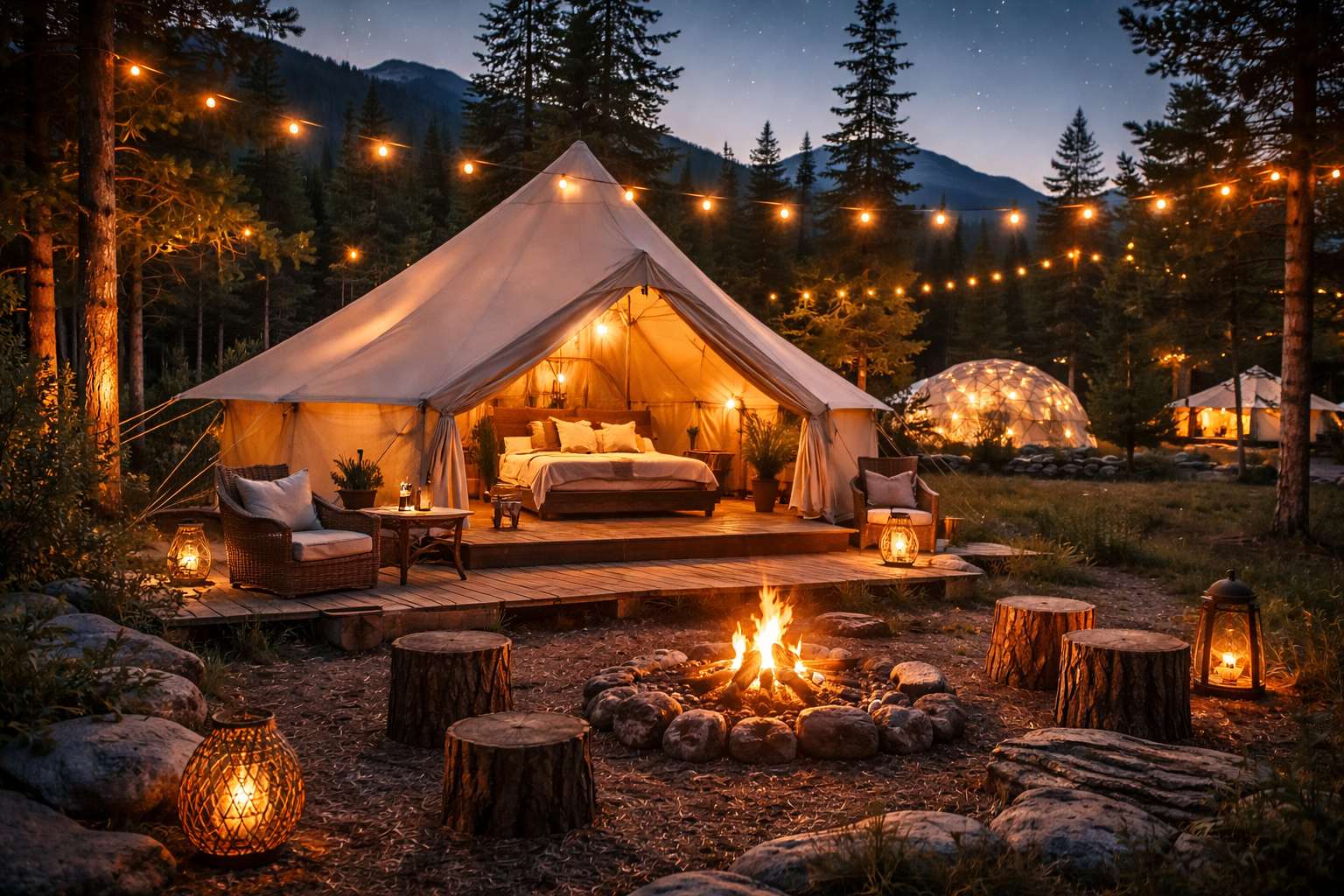
Glamping Market global Glamping Market is projected to grow from USD 2.7 billion in 2024 to USD 6.2 billion by 2032, registering a 12.6% CAGR. Glamping — the convergence of premium amenities with immersive outdoor natural settings — has graduated from a niche lifestyle trend to a mainstream luxury travel category, driven by the post-COVID experiential travel premium, millennial and Gen Z preference for Instagram-worthy nature experiences, the sustainability credentials of low-impact accommodation structures, and the scalable investment economics of glamping site development versus traditional hotel construction.
Key Takeaways
- The global Glamping Market is projected to reach USD 6.2 billion by 2032 at a 12.6% CAGR.
- Glamping ADR (Average Daily Rate) ranges from USD 180-650/night, commanding 2.4x the RevPAR of equivalent rural hotel accommodation.
- Millennial and Gen Z travellers account for 64% of glamping bookings globally, with 78% citing nature immersion as primary motivation.
- Eco-certified glamping resorts are commanding 22% booking premiums versus non-certified equivalents in European and North American markets.
- Glamping site development ROI averages 18-28% annually, versus 9-12% for traditional hotel new-build on comparable land parcels.
Segment & Technology Breakdown
| Technology / Segment | Primary Buyer | Key Driver | Outlook |
| Luxury Safari / Tented Camps | UHNW, Honeymoon, Safari | African/Asian wildlife immersion | Highest ADR; aspirational category |
| Treehouses & Elevated Pods | Couples, Experiential | Instagrammable, forest immersion | Fastest-growing; viral social discovery |
| Yurts & Geodesic Domes | Families, Groups | Affordable glamping entry, festive events | Strong; broadest market access |
| Floating / Water Glamping | Couples, Wellness | Unique setting, lake/fjord immersion | Emerging; premium niche |
| Glamping Resorts & Clusters | Institutional Investors, REITs | Scale economics, brand consistency | Growing; institutional capital entry |
What Is Driving Demand?
Post-COVID Experiential Travel Premium
The structural reallocation of consumer travel spend from goods to experiences — amplified by the COVID-era outdoor recreation surge — has created sustained demand for nature-immersive luxury travel formats. Glamping sits at the intersection of three high-growth travel categories: wellness travel (USD 1.4 trillion market), luxury accommodation, and sustainable tourism — with travellers demonstrating 34% higher willingness-to-pay for experiential accommodation versus equivalent star-rated urban hotels.
Millennial & Gen Z Nature Experience Demand
Digital-native generations curating identity through social media are driving demand for photogenic, share-worthy accommodation experiences that combine natural settings with premium comfort. Glamping sites generate 3.8x higher organic Instagram UGC per guest night versus comparable resort properties — creating a virtuous discovery loop where guest content drives direct booking traffic at near-zero customer acquisition cost.
Sustainable Hospitality & Eco-Certification Premium
Glamping structures (geodesic domes, tented camps, treehouses) inherently align with low-impact land use, reversible construction, and eco-system integration — commanding GSTC, Green Key, and Rainforest Alliance certifications that generate 22% booking premiums in sustainability-conscious European and North American traveller segments and reduce land permit approval timelines by 40% versus permanent hotel construction.
Glamping Site Development Economics
The capital efficiency of glamping site development (USD 35,000-120,000 per unit versus USD 150,000-400,000 per hotel room) combined with RevPAR premiums of 2.4x versus rural hotels creates ROI profiles of 18-28% annually — attracting institutional capital, Airbnb-era entrepreneurs, and farmland/forest estate owners seeking hospitality revenue diversification from existing land assets without planning permission complexity.
Platform Economy & Online Discovery Acceleration
Glamping-specific booking platforms (Glampglamping, Hipcamp, Pitchup, Under Canvas direct booking) and Airbnb/Booking.com glamping category expansion are reducing guest acquisition costs for independent operators by 58% versus traditional hospitality distribution channels — enabling boutique operators to achieve 70-85% occupancy rates within 24 months of launch through platform-driven discovery at scale.
| Get the full data — free sample available:
→ Download Free Sample PDF | Includes market sizing, segmentation methodology & regional forecast tables. |
| KEY INSIGHT: Glamping resorts achieving eco-certification and social media visual identity optimisation report 82% occupancy rates at 16+ weeks advance booking windows, with RevPAR of USD 280-420/night — generating EBITDA margins of 38-52% on stabilised operations versus 18-28% for comparable conventional rural hotels, driven by lower staffing ratios, premium positioning, and zero-cost UGC marketing through guest social content. |
Regional Market Breakdown
| Region | Maturity | Key Drivers | Outlook |
| North America | Dominant | National park adjacency, farmstay, Under Canvas/Collective Retreats brands | Steady; institutional capital entry |
| Europe | Mature | UK glamping festivals, Scandinavia cabins, Italy/France agritourism | Strong; eco-tourism premium |
| Asia-Pacific | Fastest Growing | Japan forest bathing, Australia outback, SE Asia jungle retreats | Highest CAGR; wellness travel demand |
| Africa | High Potential | Safari tented camp luxury, wildlife conservation glamping | Premium; highest ADR globally |
| Latin America | Emerging | Patagonia, Amazon, Mexico cenote eco-glamping expansion | Growing; adventure travel niche |
Competitive Landscape
Key operators include Under Canvas, Collective Retreats, Canopy & Stars, Glampglamping, AutoCamp, Sunder Bay, and international luxury safari operators (andBeyond, Singita, Wilderness Safaris). Platform ecosystems include Hipcamp, Glamping Hub, and Airbnb Unique Stays. Site design, location premium, eco-certification, and social media visual identity are primary competitive differentiators.
Outlook Through 2032
The Glamping Market through 2032 will be defined by institutional capital accelerating branded glamping resort cluster development, eco-certification becoming a mandatory booking conversion factor for sustainability-conscious travellers, platform economy discovery enabling boutique operator scale, and the expansion of glamping into emerging nature-tourism destinations across Asia-Pacific, Latin America, and Africa. Operators investing in photogenic architecture, sustainability certification, direct booking infrastructure, and experience programming will capture the highest occupancy premiums as experiential travel permanently displaces commodity accommodation in millennial and Gen Z travel budgets.
| Access complete forecasts, segment analysis & competitive intelligence:
Full Report: → Purchase the Full Glamping Market Report (2025–2032) |
Source: Wise Guy Reports | All market projections are forward-looking estimates and subject to revision.